
IDE 611 – Technologies for Instructional Settings [online]
Grade: A
Professor: Linda R.Euto
This course explores the integration of emerging technologies to enhance learning and instruction across educational and training contexts. Students critically examine various tools, evaluate their instructional value, and design technology-supported solutions tailored to specific learning environments. Emphasis is placed on aligning technology choices with instructional goals, learner needs, and contextual constraints.
These artifacts showcase the integration of emerging technologies to improve learning and instruction.
Assignment 1
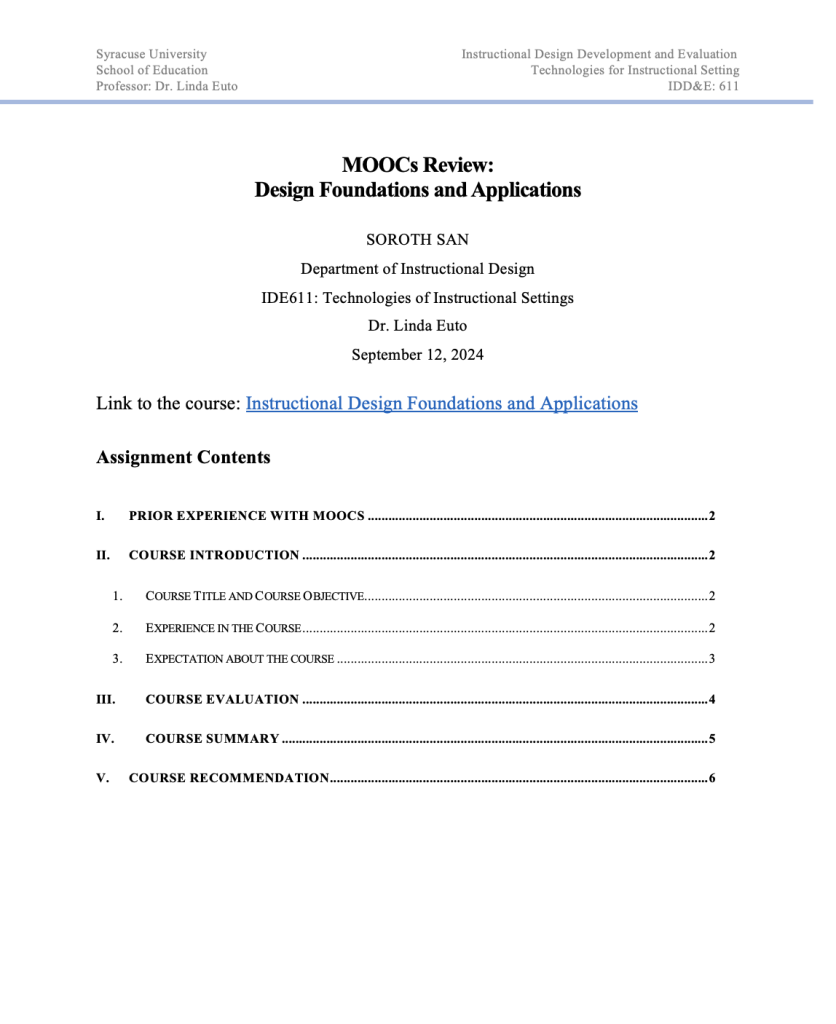
MOOC Review: Instructional Design Foundations and Applications
Project Title: MOOC Review: Instructional Design Foundations and Applications
Author: Soroth San
Project Description:
This assignment was completed for IDE 611 – Technologies for Instructional Settings [online] (Fall 2024, Syracuse University). In this individual project, I critically reviewed the Coursera MOOC Instructional Design Foundations and Applications as part of my graduate coursework in instructional technologies. Drawing from my prior experience with MOOCs and my role as an ESL lecturer, I evaluated the course structure, content, delivery methods, and learner engagement strategies through a professional lens.
The project allowed me to reflect on my learning experience, assess the strengths and limitations of the course design, and apply instructional design principles such as learner-centered approaches, needs analysis, and microlearning. I also provided constructive recommendations to enhance accessibility and engagement, particularly for international learners. This project deepened my understanding of open learning environments and strengthened my ability to evaluate instructional tools that promote equity, interactivity, and practical skill development.
View the full MOOC Review here
Assignment 2
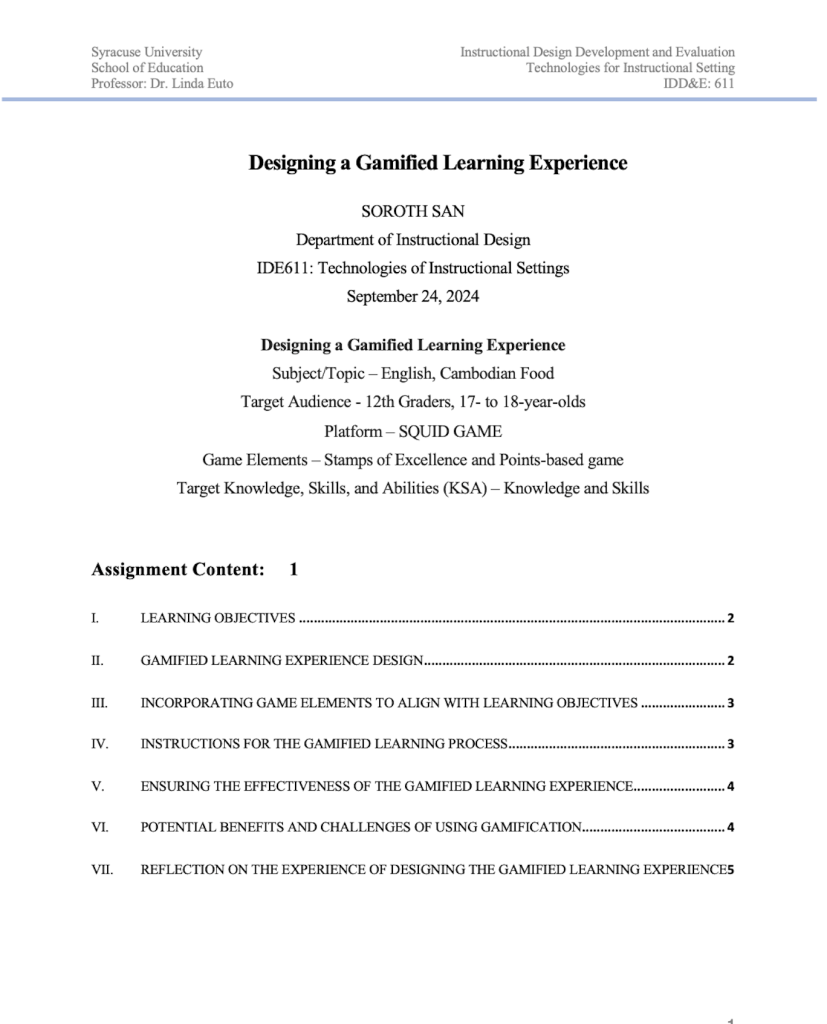
Designing a Gamified Learning Experience
Project Title: Designing a Gamified Learning Experience
Author: Soroth San
Project Description:
This assignment was completed for IDE 611 – Technologies for Instructional Settings [online] (Fall 2024, Syracuse University). In this individual project, I designed a gamified learning experience to teach Cambodian food-related English vocabulary to 12th-grade students. The activity was modeled after the Squid Game concept and structured into three progressive missions: a vocabulary matching task, a role-play scenario between a customer and waiter, and a collaborative menu-writing activity. Each mission was aligned with clearly defined learning objectives focused on vocabulary recognition, oral usage, and written application.
To enhance engagement, I incorporated game elements such as Stamps of Excellence and Participation Points. These reinforced motivation and rewarded accuracy, effort, and collaboration. The design emphasized meaningful learning by blending individual, pair, and group tasks while ensuring measurable outcomes. Reflecting on the process, I developed a deeper understanding of how to align game mechanics with instructional goals and how to balance fun, competition, and academic rigor to support student learning and retention.
View the full Gamified Learning Experience Report here
Assignment 3
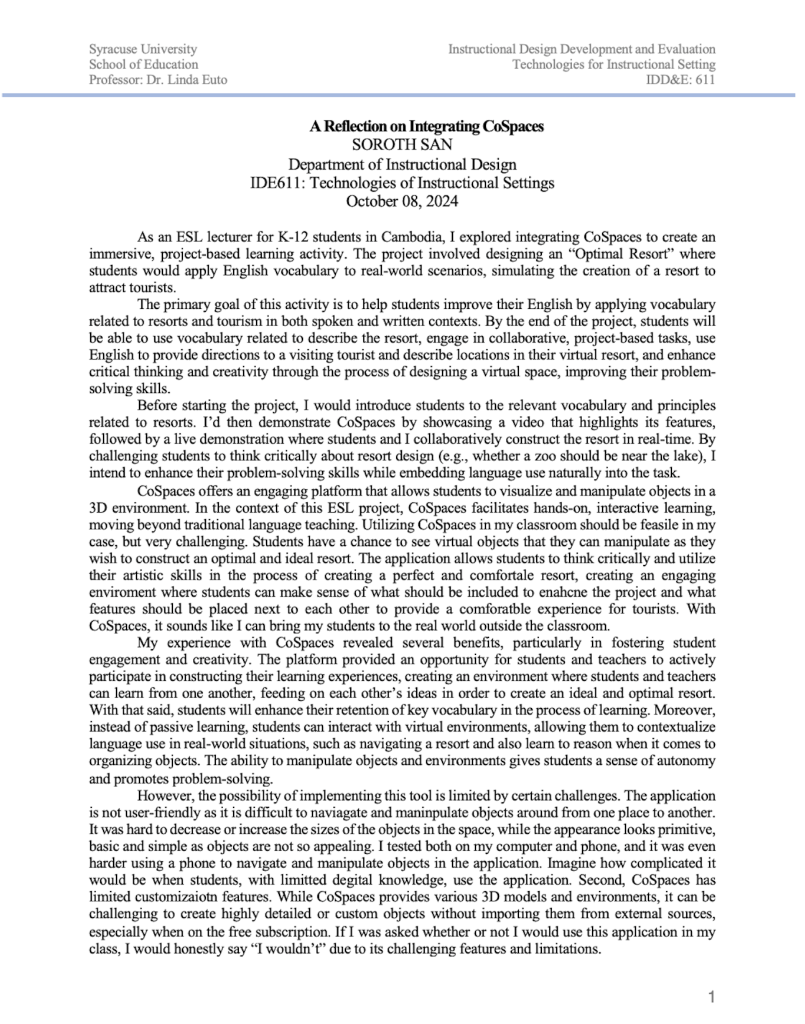
Integrating CoSpaces for ESL Vocabulary Instruction
Project Title: Integrating CoSpaces for ESL Vocabulary Instruction
Author: Soroth San
Project Description:
This assignment was completed for IDE 611 – Technologies for Instructional Settings [online] (Fall 2024, Syracuse University).In this individual project, I explored using CoSpaces to design a virtual, project-based ESL activity where students created an “Optimal Resort” using English vocabulary related to tourism. The goal was to promote language use through immersive, collaborative tasks that support creativity, critical thinking, and real-world application. While the platform fostered engagement and visualization, I identified major challenges such as limited customization and poor usability, especially for students with minimal digital skills. This project helped me critically evaluate the practicalities of integrating emerging technologies into language instruction.
View the full reflection of integrating CoSpace for ESL Instruction here
Assignment 4
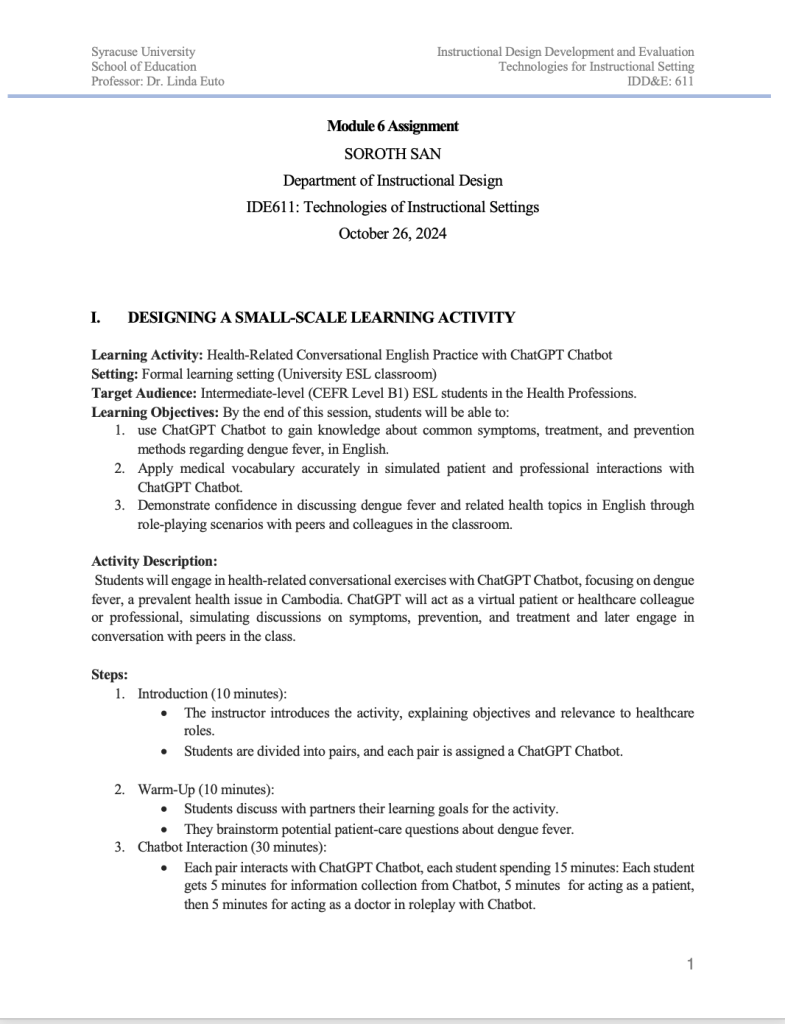
Using ChatGPT Chatbot to Support Health-Related English Language Learning
Project Title: Using ChatGPT Chatbot to Support Health-Related English Language Learning
Author: Soroth San
Project Description:
This assignment was completed for IDE 611 – Technologies for Instructional Settings [online] (Fall 2024, Syracuse University). In this individual project, I designed a small-scale ESL learning activity where health professions students practiced conversational English using ChatGPT. The chatbot simulated realistic healthcare interactions, enabling students to apply medical vocabulary and improve fluency through role-play. I reflected on ChatGPT’s effectiveness in offering real-time feedback, vocabulary support, and confidence-building opportunities. While the activity showed strong instructional potential, I also identified challenges related to response accuracy and data privacy. This project strengthened my ability to evaluate emerging technologies for meaningful language learning in specialized contexts.
View the full assignment on applying ChatGPT to support ESL learning here.
Assignment 5
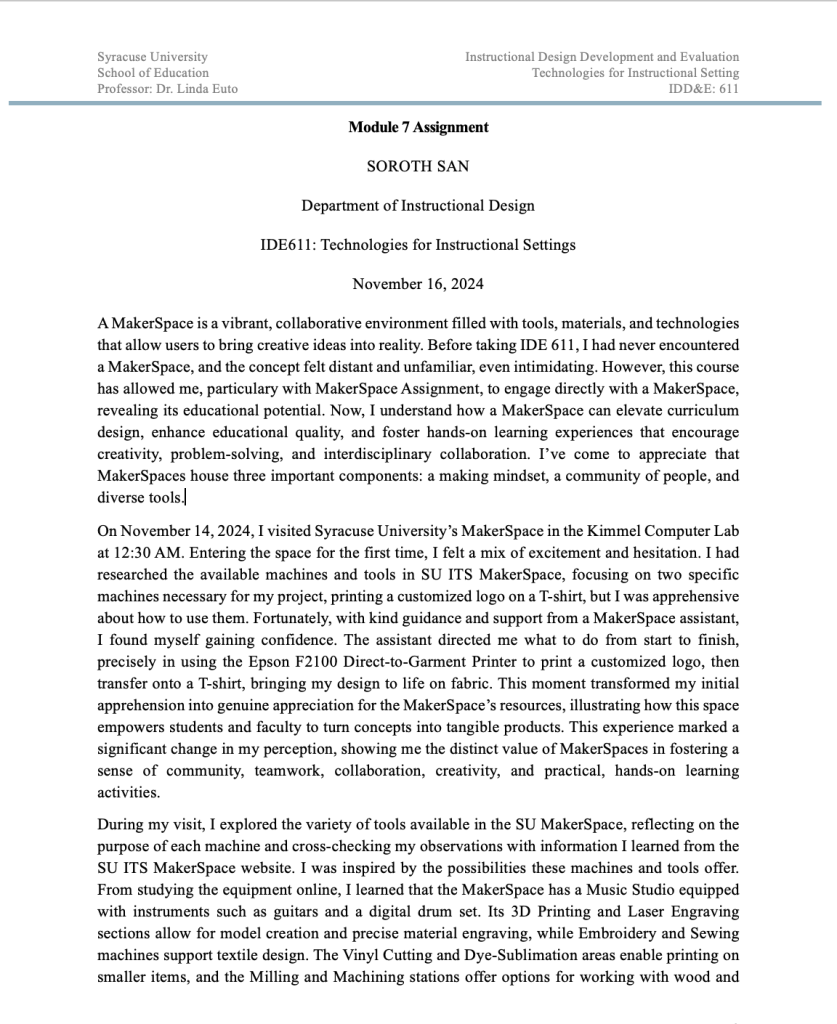
Exploring MakerSpace for Hands-On Instructional Design
Project Title: Exploring MakerSpace for Hands-On Instructional Design
Author: Soroth San
Project Description:
This assignment was completed for IDE 611 – Technologies for Instructional Settings [online] (Fall 2024, Syracuse University). In this individual project, I explored Syracuse University’s MakerSpace to design and print a customized logo T-shirt using the Epson F2100 printer. This hands-on experience deepened my understanding of how MakerSpaces support creativity, problem-solving, and experiential learning. I overcame technical challenges, collaborated with staff, and reflected on the educational value of making. This project enhanced my confidence with digital fabrication tools and reinforced the importance of preparation, communication, and real-world application in instructional design.
View the full assignment on MakerSpace exploration here.
Assignment 6
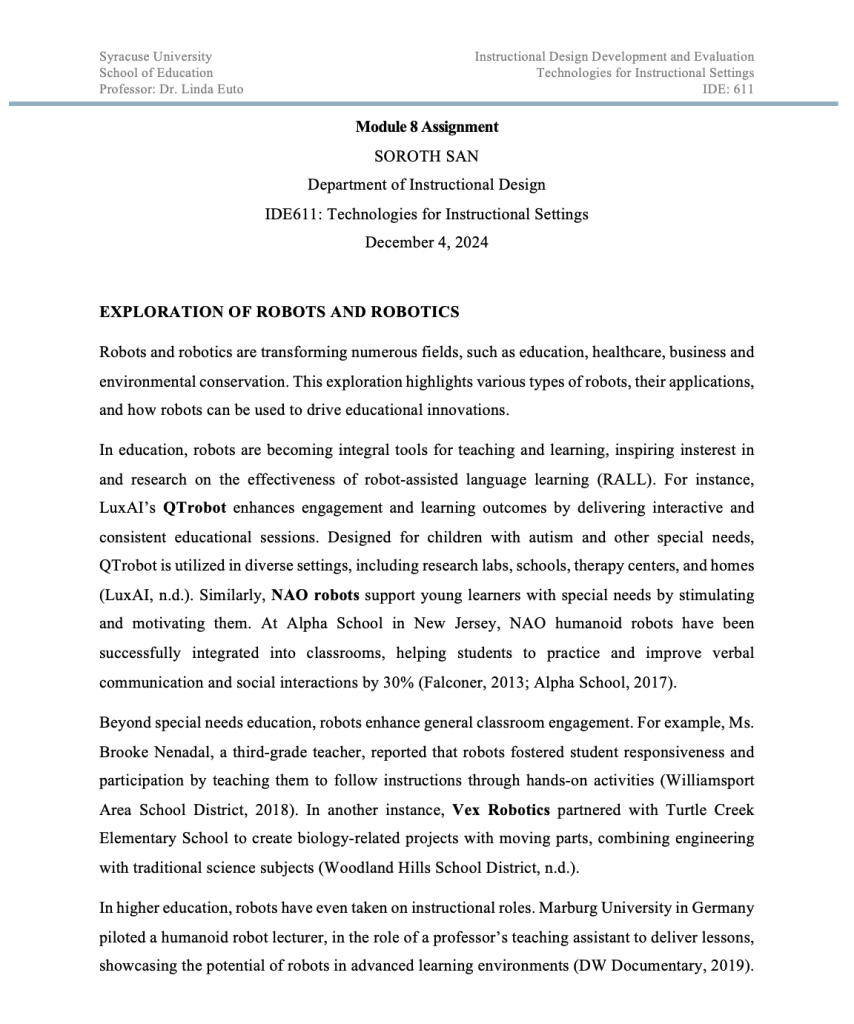
Integrating Robotics into TESOL for Health Profession Students
Project Title: Integrating Robotics into TESOL for Health Profession Students
Author: Soroth San
Project Description:
This assignment was completed for IDE 611 – Technologies for Instructional Settings [online] (Fall 2024, Syracuse University). In this individual project, I explored how educational robotics, particularly QTrobot, can enhance English language learning for health profession students. I designed a scenario-based ESL activity where students practiced medical vocabulary and patient communication through interactive role-play with QTrobot. This project deepened my understanding of robotics’ role in fostering engagement, real-time feedback, and confidence in professional language use. It also highlighted challenges such as cultural relevance and technological limitations, while reinforcing the potential of robotics to create hands-on, student-centered learning in TESOL contexts.
View the full assignment on Robotics Integration in TESOL here.
Reflection & Self-Assessment
Throughout this course, I have significantly deepened my understanding of how emerging technologies can enrich instructional design. By exploring MOOCs, chatbots, robotics, gamification, CoSpaces, and MakerSpaces, I developed a more nuanced appreciation for how these tools foster engagement, personalization, and real-world skill development. Designing activities with platforms like ChatGPT, QTrobot, and CoSpaces allowed me to integrate technology meaningfully into TESOL, while my gamified vocabulary project demonstrated how competition and collaboration can reinforce learning. The MakerSpace experience, although initially intimidating, empowered me to bring abstract ideas into tangible outcomes. These projects strengthened my instructional planning, critical thinking, and technological fluency. Challenges like tool limitations or interface issues prompted deeper reflection on accessibility, inclusivity, and learner-centered design. Collectively, these experiences transformed my instructional mindset, equipping me to design effective, interactive, and engaging training or curricula that meet diverse learner needs and reaffirming my commitment to lifelong learning and innovation in education.