
IDE 712 – Analysis for Human Performance Technology Decisions
Grade: A
Professor: Rob Pusch
This course explores the foundational principles and practical applications of Human Performance Technology (HPT). Students learn to conduct performance analyses, identify gaps, and recommend solutions that go beyond training to include organizational, environmental, and motivational interventions. Emphasis is placed on data-driven decision-making and systems thinking to support improved individual and organizational performance.
Primary Project
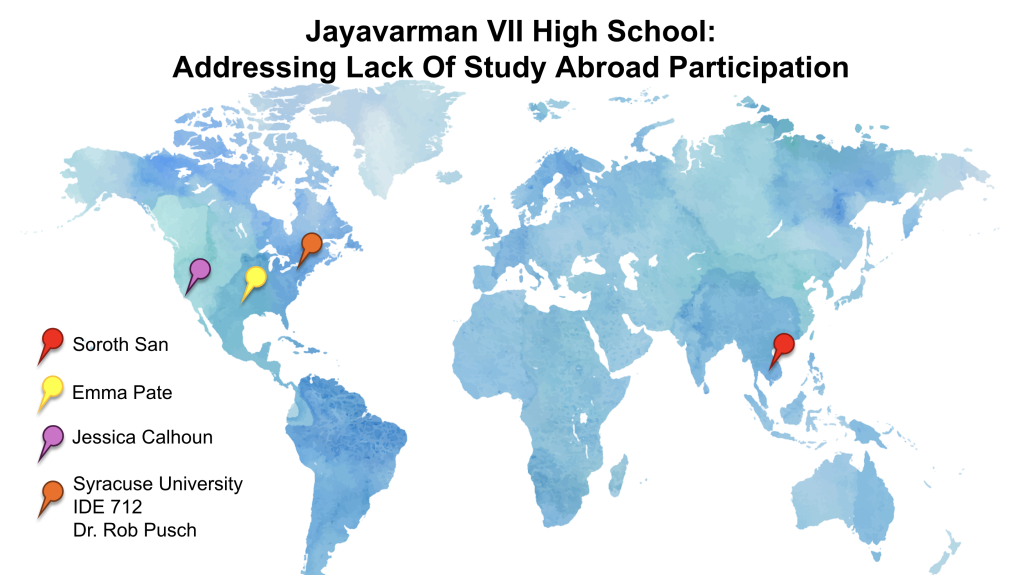
Front-End Analysis to Improve Study Abroad Participation at Jayavarman VII High School
Project Title: Front-End Analysis to Improve Study Abroad Participation at Jayavarman VII High School
Contributors: Soroth San, Emma Pate, and Jessica Calhoun
Project Description:
This course-based project was completed for IDE 712 – Analysis for Human Performance Technology Decisions (Spring 2025, Syracuse University). It investigated barriers to study abroad participation among students at Jayavarman VII High School in Cambodia. Using Human Performance Technology (HPT) frameworks and a Planning and Analysis approach, the team conducted surveys, interviews, and focus groups to identify root causes and performance gaps. Based on this Needs Assessment, the project’s Solution Design phase proposed actionable, data-driven strategies to improve study abroad involvement. For example, proposed initiatives included targeted awareness campaigns, language support workshops, and scholarship information sessions tailored to student needs. These recommendations aim to address language barriers, financial concerns, and lack of program awareness identified as key obstacles. Throughout the process, all team members contributed actively and collaboratively. I led the development of the project plan and outline, designed the report’s table of contents and cover page, and ensured consistency and accuracy through continuous editing, feedback, and coordination of both deliverables (report and presentation). This project reflects key phases of Planning and Analysis, Design and Development, and Evaluation in the IDD&E process.
View the full FEA Final Project Report here.
Reflection & Self-Assessment
This project deepened my understanding of how to conduct a comprehensive Front-End Analysis to address real-world performance problems. I learned to apply HPT frameworks, particularly Wile’s and Harless’s models, to investigate the gap between students’ aspirations and their actual participation in international education. I strengthened my skills in stakeholder analysis, PESTLE environmental scanning, and data-informed root cause analysis. One challenge was synthesizing diverse data sources, including surveys, interviews, and focus groups, into a coherent narrative while ensuring each proposed solution directly aligned with identified causes. I overcame this by applying action mapping and prioritizing practical, context-relevant strategies. This experience shifted my thinking from assuming training as the default solution to examining systemic and motivational factors. I now see performance improvement as a strategic, multi-layered process grounded in evidence. This project contributes to the field by modeling how front-end analysis can generate equitable, sustainable, and high-impact interventions tailored to underserved educational contexts.
FEA Final Project Presentation
View the full FEA Final Project Presentation here.
Secondary Projects
Cognitive Simulation: Modeling Mental Processes for Instructional Design
Project Title: Exploring Cognitive Simulation in Cognitive Task Analysis
Author: Soroth San
Project Description:
This individual project was completed for IDE 712 – Analysis for Human Performance Technology Decisions (Spring 2025, Syracuse University). The assignment focused on exploring a Cognitive Task Analysis (CTA) method relevant to instructional design. I selected cognitive simulation and examined its theoretical foundations, development process, assumptions, strengths, limitations, and applications in fields such as engineering, aviation, and TESOL.
This work reflects the Planning and Analysis component of IDD&E, as it required evaluating task complexity and instructional fit. It also aligns with Ongoing Professional Development, as I expanded my theoretical knowledge and critical thinking related to CTA methods.
Overall, the project sharpened my ability to assess instructional methods based on learner needs and context, reinforcing the importance of informed, evidence-based strategy selection in instructional design.
View the full Cognitive Simulation Presentation here.
Reflection & Self-Assessment
This project deepened my understanding of cognitive simulations as a method within Cognitive Task Analysis. I learned how cognitive simulations model complex mental processes and support instructional decision-making by transforming abstract theories into runnable, testable models. Developing the presentation strengthened my ability to synthesize theoretical foundations to real-world applications in contexts such as TESOL and engineering. A key challenge was presenting technical content in a way that was both accurate and accessible; I addressed this by incorporating engaging analogies and visual examples. This experience shifted my perspective on instructional design by highlighting the value of modeling learner cognition, not just behavior. It also reinforced the importance of aligning simulation tools with context, knowing when they are appropriate and when they are not. This project contributes to my growth as an instructional designer capable of integrating cognitive science principles into instruction that is insightful, rigorous, and contextually grounded.
Needs Assessment to Support International Students in U.S. Higher Education
Project Title: Needs Assessment
Author: Soroth San
Project Description:
This project was completed for IDE 712 – Analysis for Human Performance Technology Decisions (Spring 2025, Syracuse University). In this individual project, I conducted a comprehensive literature-based front-end analysis (FEA) to explore the academic, social, and career-related challenges faced by international students in U.S. higher education. Drawing on four key studies, I analyzed diverse needs assessment methodologies, including surveys, focus groups, and stakeholder interviews, to identify common themes, gaps, and best practices.
This project deepened my understanding of how systematic needs assessments guide evidence-based interventions. I learned the value of integrating multiple stakeholder perspectives, balancing qualitative and quantitative data, and aligning support services with the verified needs of international students. The experience strengthened my ability to synthesize research findings, critically evaluate methods, and design inclusive, data-informed strategies in instructional design and student support.
View the full Needs Assessment in Action here.
Reflection & Self-Assessment
This project significantly deepened my understanding of needs assessment and front-end analysis (FEA) as critical tools for designing effective, evidence-based interventions. Through analyzing four diverse studies, I learned to compare methodologies, assess their strengths and limitations, and synthesize common themes impacting international students, such as academic challenges, cultural adjustment, and career planning. I strengthened my skills in literature review, critical analysis, and identifying methodological gaps. One challenge was discerning between theoretical contributions and actionable findings; I addressed this by prioritizing studies that connected data to practical outcomes. This experience shifted my thinking from viewing needs assessments as one-time evaluations to seeing them as iterative, decision-support tools grounded in stakeholder perspectives. My personal experience as an international student further informed my analysis, reinforcing the importance of context-sensitive strategies. Ultimately, this project helped me develop as an instructional designer capable of using FEA to identify genuine learner needs and support inclusive, data-driven program development.