
IDE 632 – Instructional Design and Development II
Grade: A
Professor: Linda Euto
This advanced course builds on Instructional Design and Development I by engaging students in the iterative design, development, and refinement of instructional materials based on real-world needs. Emphasizing practical application, peer collaboration, and formative evaluation, students develop high-quality prototypes and conduct usability testing to strengthen their design and implementation skills.
Primary Project
The San, Pate, Calhoun Model: Increasing Study Abroad Awareness in Cambodia
Project Title: The San, Pate, Calhoun Model: Increasing Study Abroad Awareness in Cambodia
Contributors: Soroth San, Emma Pate, and Jessica Calhoun
Project Description:
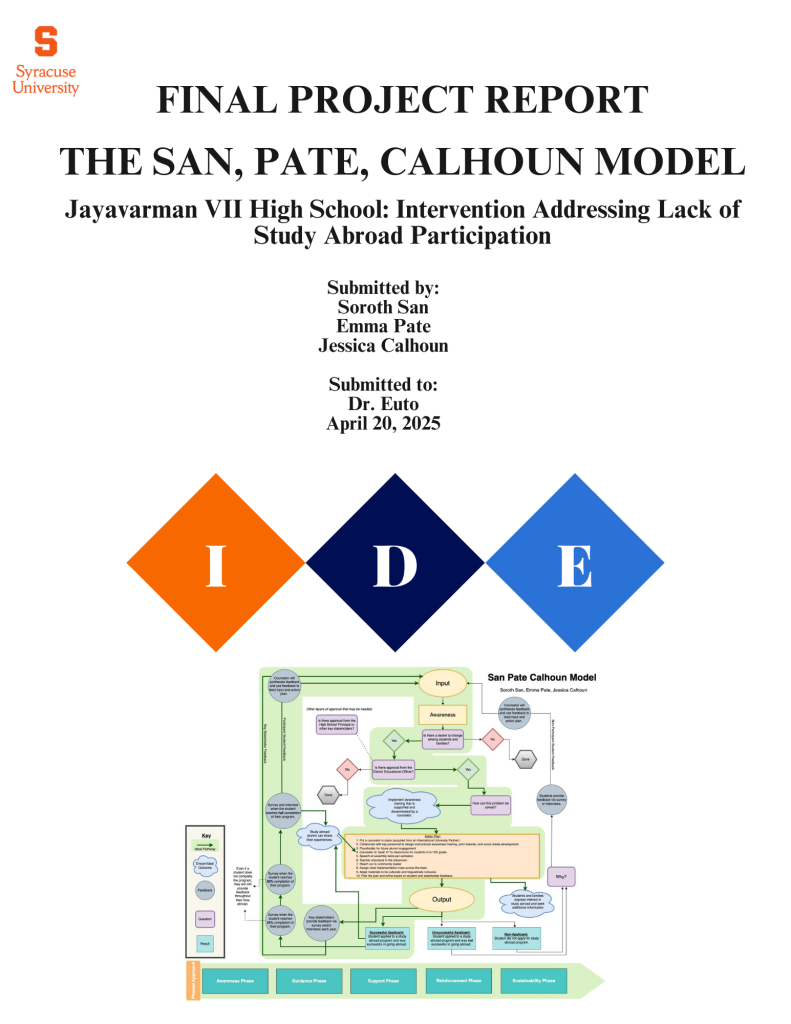
In the Spring 2025 IDE 632 course at Syracuse University, Emma Pate, Jessica Calhoun, and I jointly developed the San, Pate, Calhoun Model to increase study abroad awareness in Cambodia. The purpose of this group project was to develop a practical and culturally responsive instructional model to address the lack of awareness and support preventing Cambodian high school students from pursuing higher education abroad. Grounded in Front-End Analysis and informed by stakeholder interviews and focus groups, the project identified key barriers, including limited access to information, lack of counseling, and socio-cultural constraints, and designed a multi-phase intervention model to improve student readiness and motivation.
We addressed project phases including Planning and Analysis, Design and Development, Implementation and Evaluation, and Management and Leadership, resulting in a comprehensive instructional framework. In particular, I organized project materials by creating the table of contents, proposing content structure, synthesizing feedback from the professor and peers, outlining the report, designing the cover page, and overseeing editing and quality control for both the report and slide presentation.
Each phase was refined through iterative feedback, reflecting our commitment to instructional design best practices. Through this project, our team applied instructional design theories (e.g., Gagné’s Nine Events, Advance Organizers), change models (Rogers, Ely, Kotter), and strategic communication principles to create a scalable and sustainable solution. We learned how to synthesize data, collaborate across roles, iterate design prototypes, and produce a contextually grounded model that fosters awareness, guidance, support, reinforcement, and sustainability. The integrated contributions highlight both leadership and teamwork, culminating in a polished final report and presentation that embody the team’s shared vision, rigorous methodology, and diverse expertise.
View the full Final Project Report here.
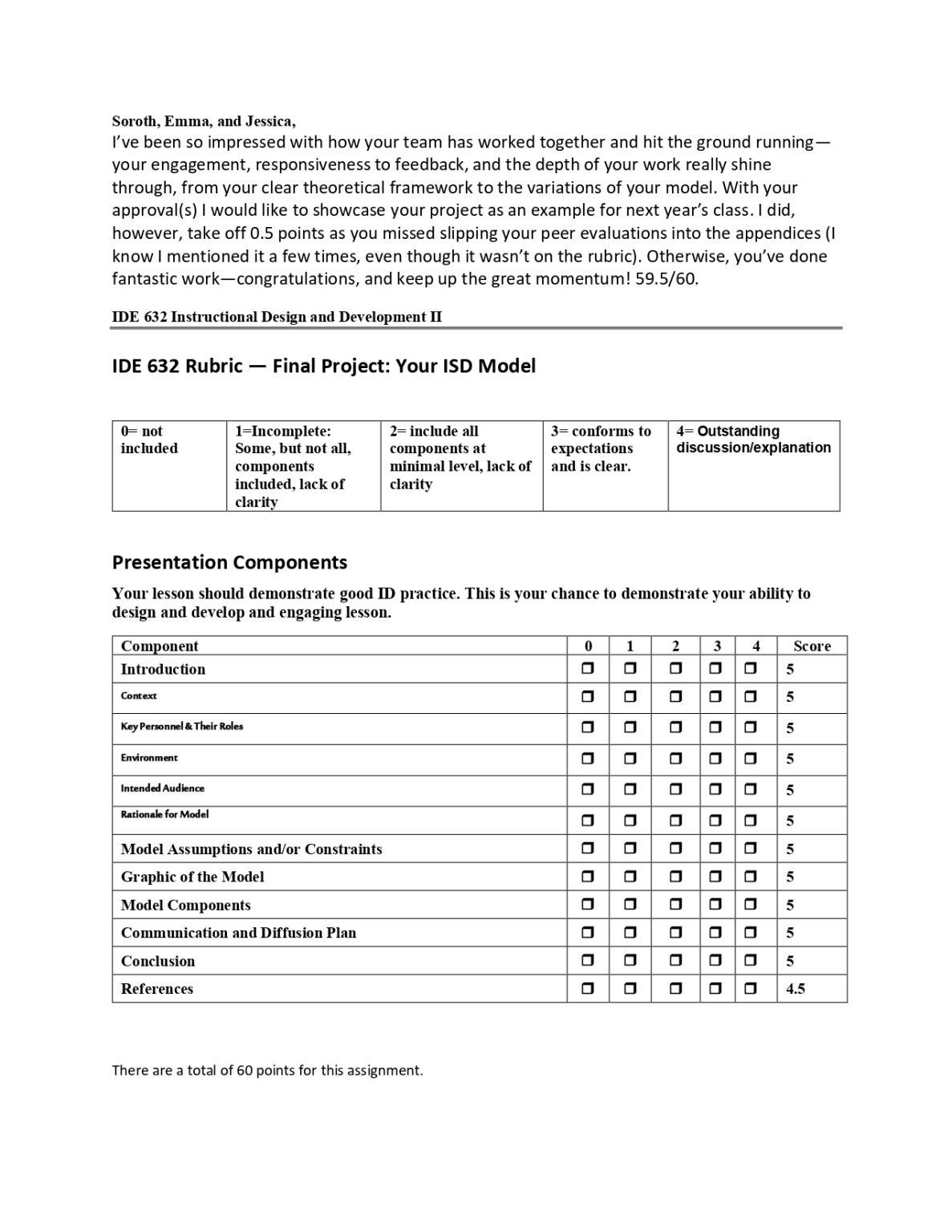
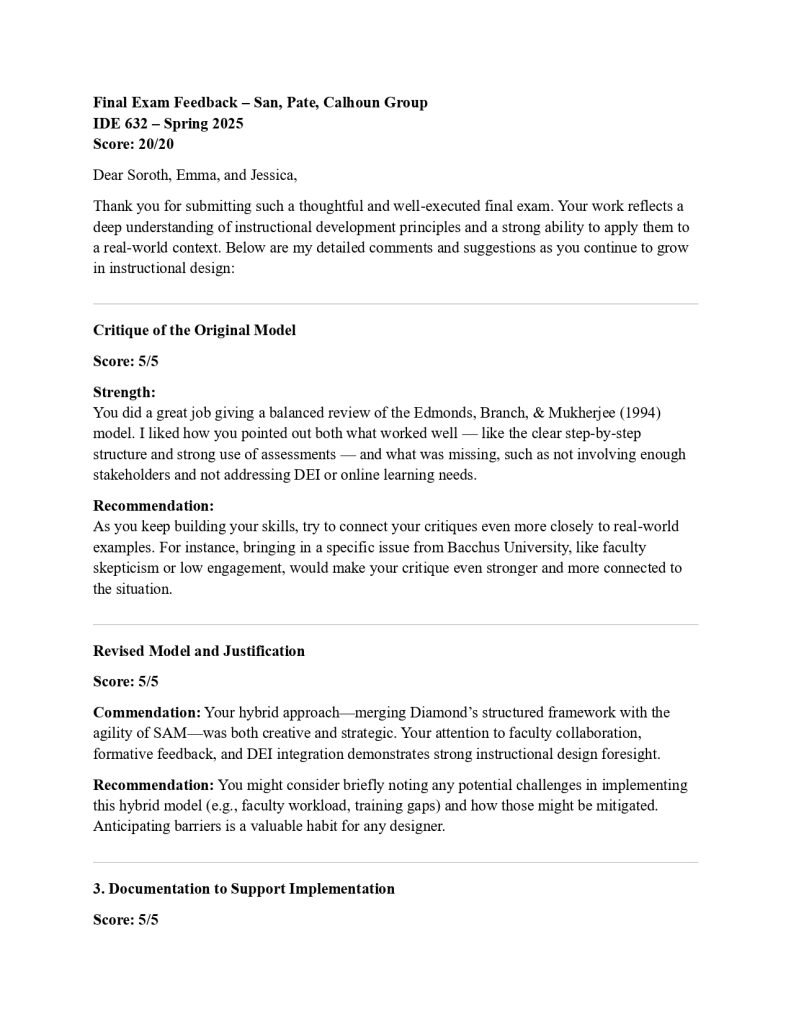
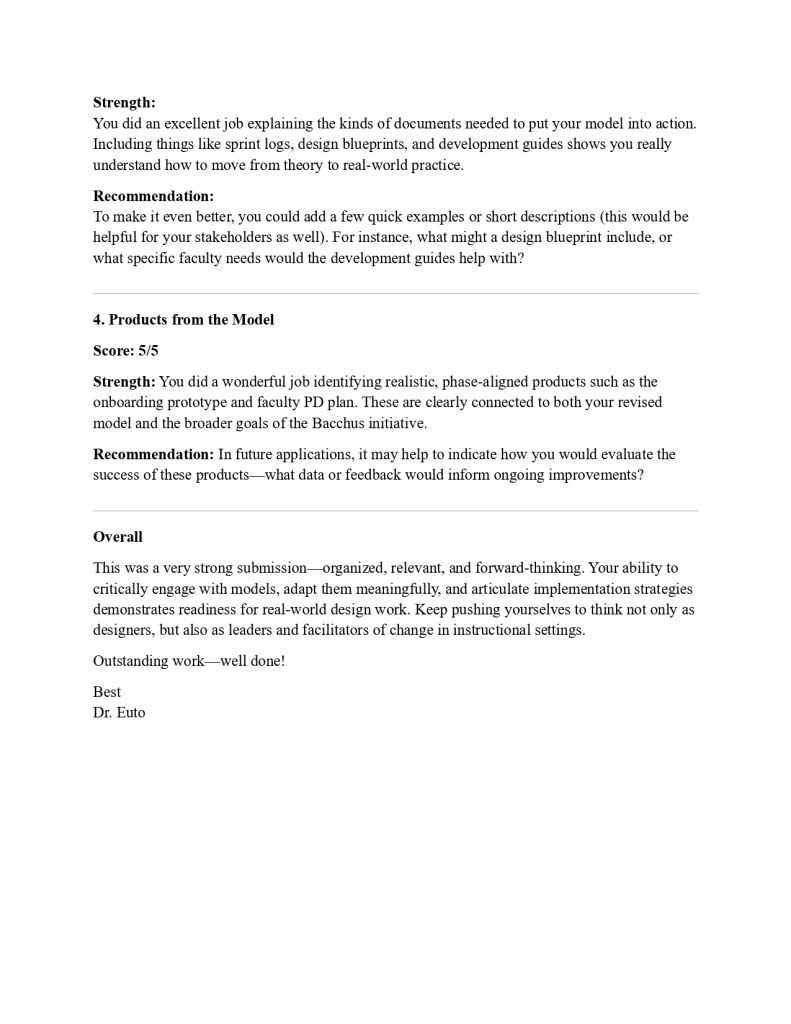
View my professor’s evaluation of our group project .
Reflection & Self-Assessment
This project strengthened my ability to integrate instructional design, front-end analysis, and change theory into a practical, context-responsive model. I learned how to investigate real-world barriers, such as lack of awareness, guidance, and support structures, and translate those findings into a multi-phase intervention tailored for Cambodian high school students. Designing the SanPateCalhoun Model allowed me to apply frameworks, such as Gagné’s Nine Events, Rogers’ Diffusion of Innovations, and Ely’s Conditions of Change in meaningful ways. One major challenge was developing a model that could visually narrate the story of change. My team and I underwent an iterative process, refining the design seven times, until we achieved a version that conveyed the model’s phases in a more persuasive, compelling, and coherent visual format. This experience shifted my thinking from theoretical application to systems-level design and sustainable impact. The final product contributes to the field by demonstrating how instructional design can address complex social challenges through scalable, culturally grounded solutions.
Final Project Presentation
View the full Final Project Report Presentation here.
Secondary Project
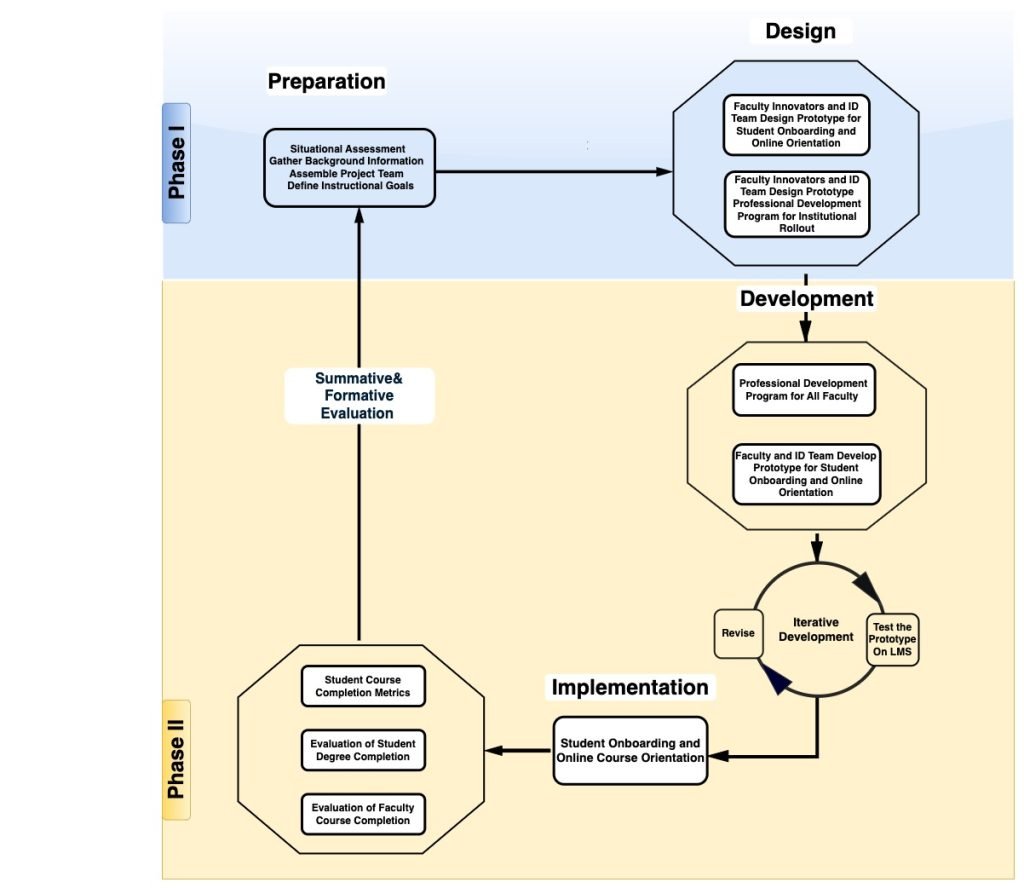
Redesigning a Better Model- Instructional Design for Distance Education at Bacchus University
Project Title: Instructional Development Model Evaluation and Adaptation – Bacchus University Distance Education Initiative
Contributors: Soroth San, Emma Pate, and Jessica Calhoun
Project Description:
In our final project for IDE 632, we employed a collaborative and reflective approach to revising the instructional development model for Bacchus University’s online Associate of Arts program. The purpose of this group assignment was to evaluate and refine an instructional development model specifically for creating distance education courses at the university.
After interviewing the client, Dr. J. Cousteau, and considering faculty concerns and the lack of documentation, our team critiqued the model, proposed context-specific revisions, identified necessary supporting documents, and outlined key deliverables from each phase. This work applied instructional design principles to produce a more practical and impactful model that supports the university’s goal of launching an associate of arts degree online.
In our refined model, we explicitly addressed every stage of the IDD&E process: Design and Development involved creating prototypes and course materials aligned with the hybrid model; Implementation and Evaluation included pilot testing in an online course and analyzing learner feedback; and Management and Leadership was demonstrated through coordinated team oversight and quality assurance. The report and presentation reflect our group’s collective leadership, detailed documentation, and commitment to quality.
In summary, this project showcases how integrating structured and iterative design methodologies, driven by collaborative leadership and reflection, produces a practical instructional solution for Bacchus University’s distance education initiative, ready for real-world implementation. As a capstone, it exemplifies how IDD&E theory can be systematically applied to solve many genuine educational challenges overall.
View the full Final Project Report here.
View my professor’s evaluation of our group project.
Reflection & Self-Assessment
This group project significantly deepened my understanding of how to critically evaluate and adapt instructional design models for large-scale online learning initiatives. One of the initial challenges I faced was designing effective interview questions that could elicit meaningful insights from the client. Although I was confident in my preparation, I realized that asking the right questions requires a nuanced understanding of stakeholder needs, a skill I developed further through feedback and collaboration with my team.
My teammate and I began by analyzing the case study scenario and collaboratively prepared the interview questions to explore the client’s goals, expectations, and transition plans. Gathering this information helped me apply Planning and Analysis competencies, particularly in identifying performance gaps and learner needs. Synthesizing the data to evaluate the original model pushed me to think more critically and strategically.
Another challenge was refining the model itself. Adapting and integrating elements from the Diamond Model and SAM2 required me to balance structure with flexibility. Through this, I strengthened my competencies in Design and Development and Implementation and Evaluation, learning to align instructional decisions with stakeholder goals while maintaining responsiveness to change.
This experience also helped me grow in Management and Leadership as I took initiative in outlining the report, contributing to team planning, and ensuring quality across deliverables. Ultimately, this project shifted my thinking toward iterative, collaborative design that emphasizes continuous improvement. The finalized hybrid model we produced reflects both theory and practicality, supporting scalable, learner-centered online course development aligned with institutional goals.