
IDE 737 – Advanced Instructional Design (Capstone Course) [Independent Study)
Grade: A
Professor: Xiaoxia Silvie Huang
This course deepens students’ expertise in instructional design by engaging them in complex, real-world projects that require the application of advanced design models, tools, and evaluation strategies. Students refine their ability to manage design processes, analyze learning environments, and implement high-impact instructional solutions across varied contexts.
Effective Patient Communication Techniques for Health Professionals
Project Title: Effective Patient Communication Techniques for Health Professionals
Contributors: Soroth San
Project Description:
This Capstone Website project was completed for IDE 737 – Advanced Instructional Design (Capstone Course) at Syracuse University in Summer 2025. It represents the culmination of my instructional design training by showcasing my competencies through the development of a complete instructional unit titled Effective Patient Communication Techniques for Health Professionals, tailored for third-year undergraduate students majoring in nursing, medicine, or public health.
These students had typically completed foundational coursework in medical terminology, ethics, and introductory patient care but had received minimal structured training in patient communication beyond simulations and internships. To address this gap, I designed a 2-hour in-person session that strengthens patient-centered communication through interactive case-based discussions, role-play exercises, and guided reflection. With an emphasis on cultural awareness, sensitivity, and empathy, students practiced key communication techniques such as active listening, open-ended questioning, ask-tell-ask, plain language explanation, and the teach-back method using both printed and digital tools. The goal was to help future health professionals communicate more clearly, confidently, and compassionately in clinical settings.
This project integrated the instructional design competencies of Planning and Analysis, Design and Development, and Implementation and Evaluation. I conducted a learner and contextual needs analysis, designed authentic case scenarios, created instructional materials, and developed assessment tools. I engaged in an iterative design process by refining the instructional unit through multiple revisions of the storyboard. I also conducted a personal evaluation using an instructional critique framework and incorporated peer instructional critiques, professor feedback, and expert consultations. These included interviews with a physician assistant with 46 years of clinical experience and a professor with 49 years of teaching experience, whose feedback helped validate the instructional relevance and usability of the unit.
The Capstone Website includes five key components: Storyboard, Instructor Resources/Guides, Learner Resources/Guide, Reflection Journal, and Instructional Critiques, where feedback and comments were collected from peers, the professor, and two experts. I also applied cognitive and reflective learning strategies to foster deep learning and skill transfer among students.
Through this project, I applied key instructional design principles such as Merrill’s First Principles of Instruction, Gagné’s Nine Events of Instruction, and learner-centered pedagogy. The final product is a focused instructional unit that evolved into a comprehensive, learner-centered experience. It demonstrates my growth as an instructional designer and prepares students to face real-world patient communication challenges with empathy, confidence, and cultural awareness.
View the Full Capstone Project Website here.
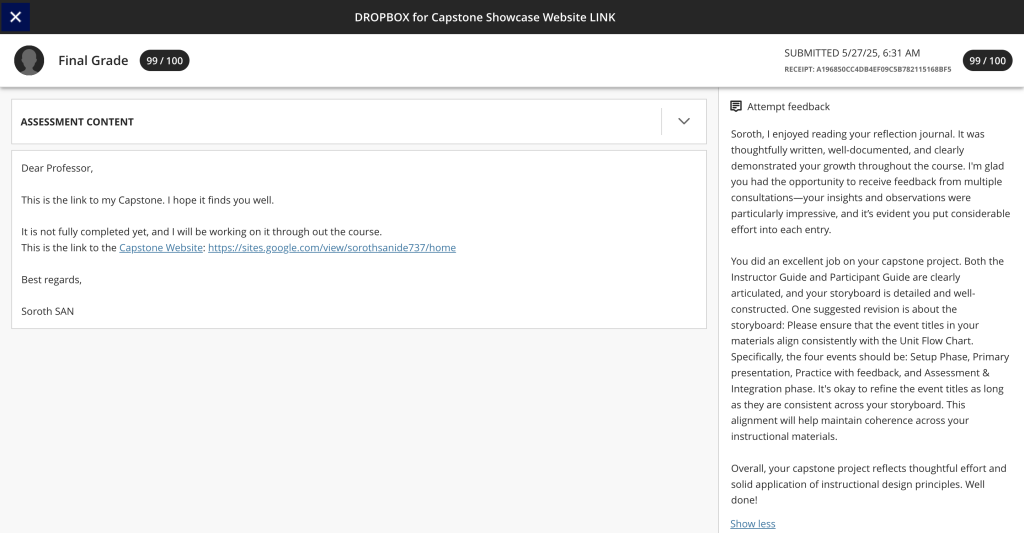
View my professor’s evaluation of the capstone project.
Reflection & Self-Assessment
Engaging in this Capstone project deepened my understanding of instructional design as both a systematic and reflective practice. Designing an instructional unit on effective patient communication allowed me to integrate key principles from theory into real-world application, particularly Gagné’s Nine Events, Merrill’s First Principles, and strategies that emphasize learner-centered, culturally responsive instruction. One of the most meaningful aspects of this process was applying iterative evaluation. Through structured self-assessment, peer feedback, and expert critiques, from both medical and instructional design perspectives, I revised the unit multiple times to enhance clarity, instructional flow, and learner engagement.
A major challenge involved aligning the medical content with instructional strategies that would be both practical and engaging for students with diverse clinical backgrounds. I overcame this by refining my storyboard and adjusting activities to be more interactive and contextually relevant. This experience reshaped my view of evaluation, not merely as a concluding step, but as an ongoing, formative process essential to meaningful learning design.
Ultimately, this Capstone project strengthened my competencies in planning, designing, and evaluating instruction. It also affirmed my identity as a thoughtful, flexible instructional designer, one who values collaboration, critical reflection, and learner experience at the heart of design.