
IDE 772 – Educational Technology in International Settings [online]
Grade: A
Professor: Jing Lei
This course examines the challenges and opportunities of integrating educational technology in diverse international contexts. Students explore cross-cultural factors, policy environments, and infrastructure constraints while designing contextually responsive technology-based instructional solutions. Emphasis is placed on ethical implementation, sustainability, and culturally relevant practices in global education settings.
Book Chapter: Educational Consultant’s Guide to Effective Use of AI Technology in International Settings: Germany
Project Title: Book Chapter: Educational Consultant’s Guide to Effective Use of AI Technology in International Settings: Germany
Authors: Soroth San & Emma Pate
Project Description:
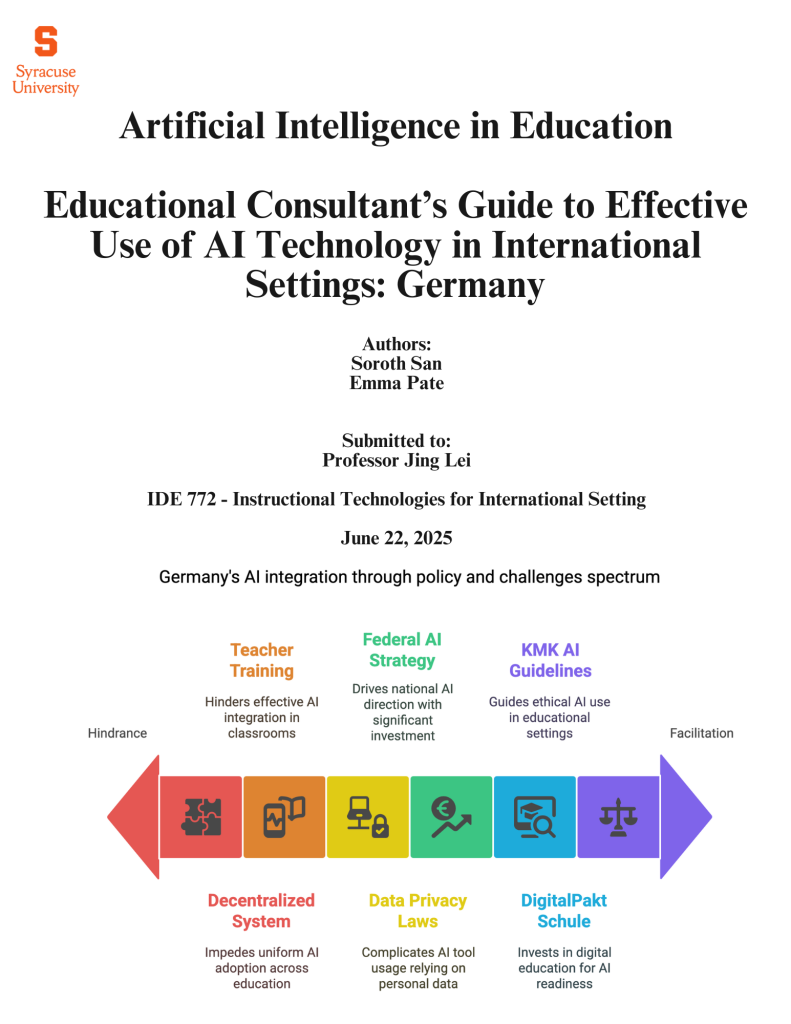
This course-based project was developed for IDE 772 – Educational Technology in International Settings [online] during Summer 2025 at Syracuse University. The final deliverable was a co-authored book chapter titled “AI in Education in Germany,” which presents a detailed, research-based analysis of how artificial intelligence is being integrated into Germany’s education system. The project examines key aspects including the historical development of educational technologies, major policy reforms, national strategies such as the Federal AI Strategy (2018–2025), the DigitalPakt Schule initiative, and the KMK’s 2024 guidelines promoting critical AI engagement in schools.
My individual contributions included drafting major sections of the chapter, including Introduction, Country Context, Educational Technology, AI Technology in Germany, and Educational AI Technology Resources, as well as verifying hyperlinks, checking citation accuracy, and creating the cover page. Then, my co-author and I worked collaboratively to consolidate our drafts into a cohesive final version. The project applied principles of instructional design, strategic planning, and cross-cultural analysis to understand the benefits and barriers of AI implementation. It highlights issues such as teacher readiness, ethical standards, privacy concerns under GDPR/BDSG, and infrastructural disparities. The chapter ultimately serves as a policy-informed educational resource for stakeholders interested in aligning AI integration with responsible and equitable instructional practices.
View the Full Book Chapter here.
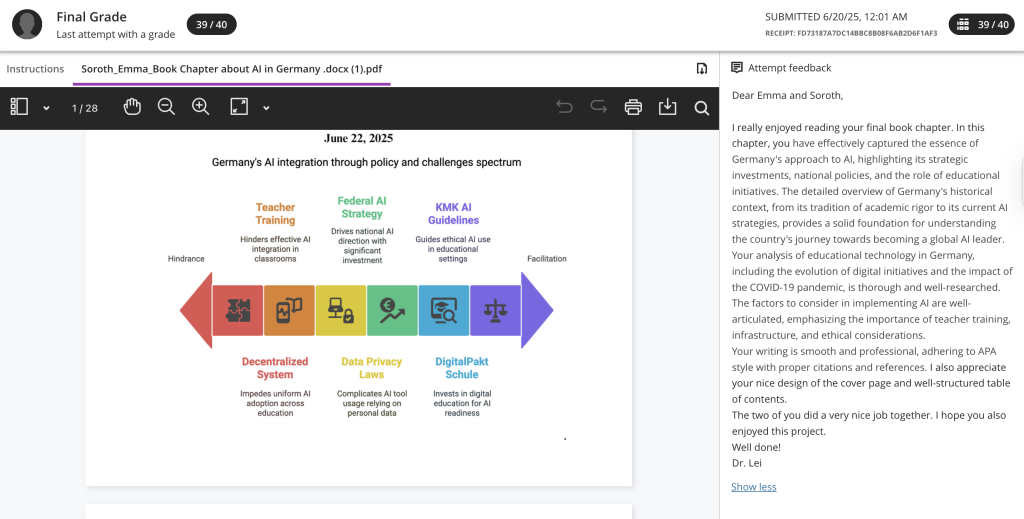
View my professor’s evaluation of the project.
Reflection & Self-Assessment
Participating in this book chapter project deepened my understanding of educational systems analysis and instructional design in a global context. By exploring Germany’s approach to AI in education, I gained valuable insight into how federal structures, cultural values, and legal frameworks influence innovation in teaching and learning. This project pushed me to think beyond technical implementation and engage with the ethical, political, and infrastructural dimensions of educational technology.
A key challenge involved translating complex policy documents into concise, accessible, and pedagogically meaningful content. I addressed this by sharpening my academic writing, emphasizing clarity, and aligning the information with instructional relevance. Collaborating with my co-author, Emma, further strengthened my communication and editing skills as we worked to integrate our distinct perspectives into a coherent and well-structured chapter.
This experience reaffirmed that instructional design is not only about developing materials but also about critically examining educational systems, anticipating learner needs, and articulating insights across diverse contexts. I now feel more confident in my ability to contribute to interdisciplinary educational initiatives that require research synthesis, policy analysis, and thoughtful design. Above all, this project enriched my perspective on how to support digital transformation in education responsibly and effectively.